
November 17, 2026Freight9 min readBy Sachin
How to Calculate Chargeable Weight in Air Freight
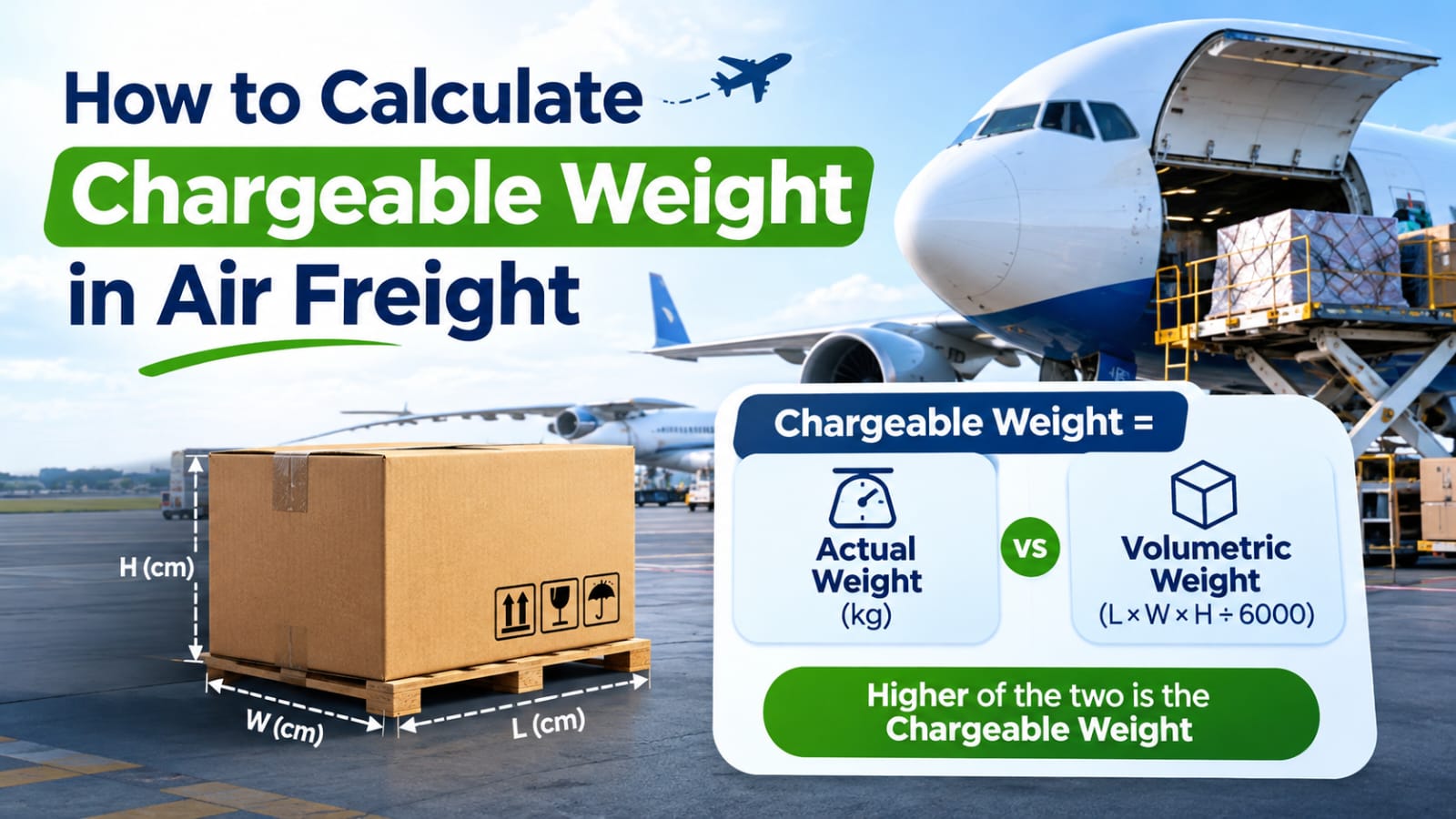
When shipping goods by air, the weight of your cargo is not always the weight you pay for. Airlines and freight carriers consider both the physical weight of a shipment and the space it occupies inside an aircraft. This is why understanding **how to calculate chargeable weight** is essential for businesses involved in international trade.
A lightweight shipment with large dimensions may cost more to transport than a compact, heavier shipment. The difference is determined by a calculation known as volumetric weight or dimensional weight.
In this guide, we explain how chargeable weight is calculated, the volumetric weight air freight formula, how major courier companies determine billable weight, and how these calculations affect your air cargo costs.
## What Is Chargeable Weight in Air Freight?
Chargeable weight is the weight used by an airline or freight carrier to calculate the transportation cost of a shipment.
It is determined by comparing two measurements:
- **Actual Gross Weight:** The physical weight of the cargo, including its packaging.
- **Volumetric Weight:** The calculated weight based on the shipment's dimensions and the carrier's applicable conversion factor.
The higher of these two values is generally considered the chargeable weight.
For example, if a shipment has an actual gross weight of 80 kg and a volumetric weight of 110 kg, the freight charges will generally be calculated on 110 kg.
This approach ensures that shipments occupying significant cargo space are priced according to the capacity they use, even if they are relatively lightweight.
## Actual Weight vs. Volumetric Weight
Before calculating chargeable weight, it is important to understand the difference between actual and volumetric weight.
| Measurement | Meaning |
|---|---|
| Actual Gross Weight | Physical weight of the packed shipment |
| Volumetric Weight | Calculated weight based on package dimensions |
| Chargeable Weight | Higher of actual gross weight and volumetric weight |
**Example:**
Consider a shipment with the following details:
- Actual gross weight: 45 kg
- Dimensions: 100 × 80 × 60 cm
- Volumetric divisor: 6000
Volumetric weight:
100 × 80 × 60 ÷ 6000 = 80 kg
Since the volumetric weight (80 kg) is higher than the actual weight (45 kg), the chargeable weight is **80 kg**.
## Volumetric Weight Air Freight Formula
The volumetric weight air freight formula converts the dimensions of a shipment into an equivalent weight.
For standard air freight calculations using a divisor of 6000, the formula is:
**Volumetric Weight (kg) = Length (cm) × Width (cm) × Height (cm) ÷ 6000**
The divisor represents the volume-to-weight conversion factor used for the applicable service.
However, the divisor is not universal. Express couriers and different airline or freight services may use different conversion factors. Always confirm the applicable divisor before estimating shipping costs.
### Example: How to Calculate Volumetric Weight
Suppose you are exporting a shipment with these dimensions:
- Length: 120 cm
- Width: 80 cm
- Height: 70 cm
- Actual gross weight: 65 kg
**Step 1: Calculate the shipment volume**
120 × 80 × 70 = 672,000 cubic cm
**Step 2: Apply the volumetric divisor**
672,000 ÷ 6000 = 112 kg
**Step 3: Compare actual and volumetric weight**
- Actual gross weight: 65 kg
- Volumetric weight: 112 kg
**Final Chargeable Weight: 112 kg**
The shipment will generally be rated at 112 kg under this example's pricing basis.
## How to Calculate Chargeable Weight: Step-by-Step
Follow these steps to calculate the chargeable weight of an air freight shipment.
**Step 1: Measure the packed cargo**
Measure the length, width and height of each carton or package after packing. Use centimetres for the formula above.
**Step 2: Record the actual gross weight**
Weigh the complete packed shipment, including cartons, pallets and other packaging where applicable.
**Step 3: Calculate volumetric weight**
Multiply the length, width and height, then divide the result by the applicable volumetric divisor.
**Step 4: Compare both weights**
Compare the actual gross weight with the calculated volumetric weight.
**Step 5: Determine chargeable weight**
Use the higher value as the chargeable weight, subject to the carrier's rounding, minimum-weight and shipment-level rules.
For shipments containing multiple packages, calculate each package separately where the carrier requires it, then apply the carrier's rules for combining and rounding the weights.
## Air Cargo Cost Calculation: How Is the Freight Rate Determined?
Once the chargeable weight is established, the basic air freight cost can be estimated using the agreed rate per kilogram.
**Air Freight Cost = Chargeable Weight × Freight Rate per Kg**
For example:
- Chargeable weight: 112 kg
- Air freight rate: ₹250 per kg
112 × ₹250 = **₹28,000**
The estimated base air freight cost is ₹28,000.
However, the final invoice may include additional charges depending on the shipment, route and service. These can include:
- Fuel surcharge
- Security or screening charges
- Terminal handling charges
- Customs clearance fees
- Documentation charges
- Pickup and delivery costs
- Cargo insurance, if selected
- Applicable taxes and duties
Therefore, the final shipping cost may differ from the basic freight calculation. Request a detailed quotation to understand all applicable charges before confirming a shipment.
## How Do DHL, FedEx, UPS, TNT and Canada Post Calculate Air Freight Charges?
Major international courier and parcel carriers generally compare actual weight with dimensional or volumetric weight. The higher value is used to determine the billable weight, subject to their service-specific rules.
However, their conversion factors and rounding policies can differ.
Here is an overview of commonly published calculation methods:
### 1. DHL Express
DHL Express commonly calculates volumetric weight using a divisor of 5000 when dimensions are measured in centimetres and weight is expressed in kilograms.
**Formula:**
Length × Width × Height ÷ 5000
DHL compares the calculated volumetric weight with the actual weight and generally uses the higher value for rating.
### 2. FedEx
FedEx uses dimensional weight pricing for eligible shipments. Its published US guidance calculates dimensional weight using a divisor of 139 for dimensions in inches and weight in pounds.
For metric calculations, the applicable conversion factor and service rules should be confirmed with the local FedEx rate guide or shipping tool.
### 3. UPS
UPS India publishes a dimensional weight formula using a divisor of 5000 for measurements in centimetres.
**Formula:**
Length × Width × Height ÷ 5000
UPS compares dimensional weight with actual weight to determine billable weight. Its rounding rules and minimum billable weights may also apply, depending on the shipment type.
### 4. TNT
TNT publishes volumetric conversion factors based on the service selected:
- Express services: Length (m) × Width (m) × Height (m) × 200
- Economy services: Length (m) × Width (m) × Height (m) × 250
The applicable factor should be checked against the selected service and destination.
### 5. Canada Post
Canada Post uses dimensional weight for several parcel services, including Priority, Xpresspost and Expedited Parcel, as well as many US and international services.
Its published density factors include:
- 5000 for Priority, Xpresspost, Expedited Parcel and specified US and international services.
- 6000 for Regular Parcel.
Some services, including Tracked Packet and Small Packet, are excluded from the stated US and international application. Check the relevant service guide before calculating.
### Example: How Different Divisors Affect Chargeable Weight
Consider a package with the following details:
- Length: 60 cm
- Width: 50 cm
- Height: 40 cm
- Actual weight: 18 kg
| Divisor | Volumetric Weight | Chargeable Weight |
|---|---:|---:|
| 6000 | 20 kg | 20 kg |
| 5000 | 24 kg | 24 kg |
The same package can have a different billable weight depending on the carrier's conversion factor.
**Important:** These examples illustrate how the divisor affects the calculation. They are not a guarantee of the final rate or billable weight for every service. Carrier rules for measurement, rounding, minimum charges, individual packages and destinations may apply. Always verify the current service-specific terms before booking.
## How to Reduce Air Freight Costs
Understanding chargeable weight can help businesses identify opportunities to reduce unnecessary shipping expenses.
Here are some practical ways to manage air freight costs:
**1. Use appropriately sized packaging**
Avoid oversized cartons when the product can be safely packed in a smaller box. Unnecessary packaging increases shipment volume and may increase volumetric weight.
**2. Optimise carton dimensions**
Review carton sizes before dispatch. Even small reductions in length, width or height can make a difference when calculating volumetric weight.
**3. Consolidate shipments where practical**
Combining multiple shipments may help improve logistics efficiency and reduce separate handling or documentation costs. However, consolidation does not automatically reduce chargeable weight.
**4. Compare freight options**
Compare available airline and service options based on transit time, routing, handling requirements and total landed logistics cost—not just the quoted rate per kilogram.
**5. Confirm dimensions before booking**
Accurate measurements help avoid unexpected weight adjustments after the carrier remeasures the cargo.
**6. Request a detailed quotation**
Ask your freight forwarder to clarify the chargeable weight, applicable divisor, freight rate and additional charges before confirming the shipment.
## Frequently Asked Questions About Chargeable Weight
### 1. How do I calculate chargeable weight in air freight?
Calculate the actual gross weight and volumetric weight of your shipment. Compare both values. The higher value is generally the chargeable weight used to calculate air freight charges.
### 2. What is the volumetric weight air freight formula?
A commonly used standard air freight formula is:
Volumetric Weight (kg) = Length (cm) × Width (cm) × Height (cm) ÷ 6000
The applicable divisor may vary by airline, courier, service and agreement.
### 3. Why is volumetric weight higher than actual weight?
Volumetric weight can be higher when cargo is large but lightweight. Since the shipment occupies valuable space in an aircraft, the carrier may charge according to its calculated volumetric weight.
### 4. Do all airlines use a divisor of 6000?
No. A divisor of 6000 is commonly used in standard air freight calculations, but express courier companies and other services may use different factors. Always check the applicable carrier or airline rules.
### 5. How do DHL and FedEx calculate chargeable weight?
DHL Express commonly uses a divisor of 5000 for centimetre-based calculations. FedEx uses dimensional weight rules that vary by measurement system, service and applicable rate terms. Both compare actual and dimensional weight to determine the billable weight.
### 6. Does chargeable weight include packaging?
Yes. Actual gross weight generally includes the packaging. The package's external dimensions are also used when calculating volumetric weight.
### 7. Is chargeable weight the same as gross weight?
No. Gross weight is the physical weight of the packed shipment. Chargeable weight is the higher of actual gross weight and volumetric weight, subject to the applicable carrier rules.
## Simplify Your International Air Freight with Gxpress
Accurate chargeable weight calculations are essential for managing international shipping costs and avoiding unexpected freight adjustments.
At **Gxpress Solutions**, we support businesses with international air freight, ocean freight, customs clearance, warehousing and end-to-end logistics solutions. Our team helps importers and exporters evaluate shipping requirements, understand freight quotations and coordinate cargo movement across international markets.
Whether you are shipping commercial cargo, managing regular exports or planning international supply chains, having the right logistics partner can make a difference.
**Planning an international shipment?**
Visit [www.gxpresss.com](https://gxpresss.com) or contact our team to discuss your air freight requirements and request a shipping quotation.
**Gxpress – Your Global Logistics Partner.**
Planning an international move? Gxpress handles fixed pricing, one coordinator, no surprises.
Get a Free Quote →Share this article: